
Amines act as bases because the nitrogen atom carries a lone pair of electrons that readily accepts a proton. When an amine meets an acid, that lone pair grabs the incoming H⁺ and the molecule becomes a positively charged ammonium ion. This single behavior — proton acceptance — is what makes amines indispensable across acid-gas treating, water and boiler chemistry, corrosion control, surfactant manufacture, and epoxy curing. Below we explain the chemistry that drives amine basicity, how it shifts from one amine class to the next, and where industrial buyers actually put that basicity to work.
On this page
- Why amines are basic
- The acid–base reaction, worked through
- How basicity varies between amines
- Acid-gas treating: MEA, DEA and MDEA
- pH adjustment and neutralization
- Corrosion inhibition in boiler and oilfield systems
- Chelation and sequestration
- Surfactant and personal-care intermediates
- Epoxy curing agents
- Frequently asked questions
- Source industrial amines in bulk
Why amines are basic
An amine is ammonia with one or more hydrogens replaced by carbon-bearing groups. The nitrogen keeps a non-bonding lone pair of electrons, and that lone pair is the entire story. A Brønsted–Lowry base is any species that accepts a proton, and nitrogen’s lone pair does exactly that — it reaches out and bonds a free H⁺. The same lone pair also makes amines strong nucleophiles, which is why they show up everywhere in organic synthesis, but in water it is their proton-accepting behavior that defines them as bases.
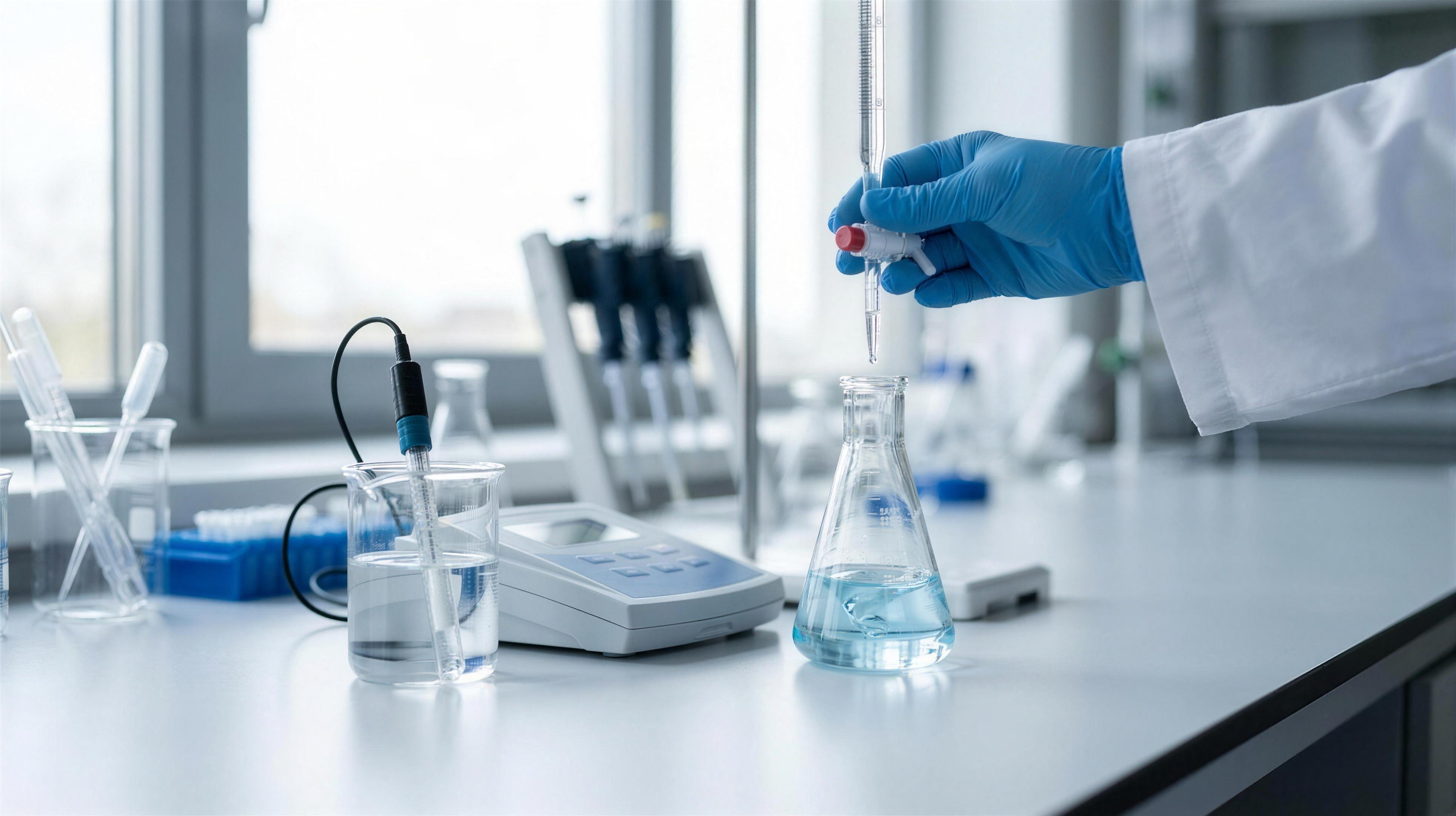
Strength gets measured two ways. The base ionization constant Kb (reported as pKb) describes how far the amine pulls a proton off water; the more common pKa refers to the conjugate acid — the protonated ammonium ion — and the two are linked by pKa + pKb = 14 at 25 °C. A higher conjugate-acid pKa means a stronger base. Simple aliphatic amines have conjugate-acid pKa values clustered roughly between 9.5 and 11, so a typical amine dissolved in water pushes the pH solidly into the alkaline range, often 11 to 12 at working concentrations. For a purchasing or formulation team, the practical takeaway is direct: choose an amine when you need a base that is liquid, miscible, buffering, and far gentler to handle than caustic soda.
The acid–base reaction, worked through
Take monoethanolamine (MEA), the workhorse alkanolamine, reacting with a generic acid that donates H⁺. The nitrogen lone pair accepts the proton and the molecule becomes a protonated ammonium cation:
HOCH2CH2NH2 + H⁺ → HOCH2CH2NH3⁺
The general pattern holds for every amine class. The nitrogen donates its lone pair to the proton and ends up carrying a formal positive charge:
- Primary amine: RNH2 + H⁺ → RNH3⁺
- Secondary amine: R2NH + H⁺ → R2NH2⁺
- Tertiary amine: R3N + H⁺ → R3NH⁺
In a real gas-treating or water system the acid is rarely a bare proton. With carbon dioxide, the amine neutralizes the carbonic acid that forms when CO2 dissolves; with hydrogen sulfide, it neutralizes a weak acid directly. The reaction is reversible, and that reversibility is the commercial point: heat the protonated amine in a stripper and it releases the acid gas and returns to its free-base form, ready to absorb again. One caution worth stating plainly — the salts formed with strong mineral acids are stable and will not regenerate thermally, which is why heat-stable salt buildup is a recurring maintenance issue in amine plants.
How basicity varies between amines
Not all amines are equally basic, and the differences are large enough to drive product selection. Three effects dominate.
Inductive effect. Alkyl groups push electron density toward nitrogen, enriching the lone pair and strengthening the base. On electronic grounds alone, more alkyl substitution should mean a stronger base.
Steric hindrance and solvation. In water the simple electronic story breaks down. Bulky groups around a tertiary nitrogen crowd the incoming proton and, more importantly, leave the resulting ammonium ion poorly solvated and less stabilized. The net result in aqueous solution is famously non-monotonic: secondary amines often edge out primary, and tertiary amines fall back rather than climbing further. This is not a textbook footnote — it is exactly why tertiary MDEA behaves so differently from primary MEA in a real absorber.
Resonance in aromatic amines. In aniline and its relatives the nitrogen lone pair delocalizes into the benzene ring, so it is no longer fully available to grab a proton. Aromatic amines are dramatically weaker bases than aliphatic ones — aniline’s conjugate acid sits near pKa 4.6, against roughly 10.6 for a typical alkylamine, a difference of about a million-fold in basicity. The recommendation that follows is simple: if your process needs proton-accepting muscle, reach for an aliphatic alkanolamine, not an aromatic amine.
| Amine class | Example | Relative basicity | Typical industrial role |
|---|---|---|---|
| Primary aliphatic | Monoethanolamine (MEA) | Strong; fast reaction | Bulk CO2/H2S removal; high capacity |
| Secondary aliphatic | Diethanolamine (DEA) | Strong; slightly less corrosive than MEA | Acid-gas treating; refinery gas |
| Tertiary aliphatic | Methyldiethanolamine (MDEA) | Moderate; slow CO2 kinetics | Selective H2S removal with CO2 slip |
| Tertiary aliphatic (alcohol amine) | Triethanolamine (TEA) | Moderate | pH buffering, surfactant salts, cement additives |
| Aromatic | Aniline | Weak (lone pair delocalized) | Dye, rubber and polymer intermediates — not a working base |
Acid-gas treating: MEA, DEA and MDEA
The largest industrial home for amine basicity is acid-gas treating — also called amine scrubbing or gas sweetening. Aqueous alkanolamine solutions strip H2S and CO2 out of natural gas, refinery streams, syngas and biogas. Sour gas flows up an absorber column while lean amine flows down; the amine’s basic nitrogen captures the acid gas, and the rich amine is then sent to a stripper where heat reverses the reaction, regenerating lean amine for another pass. The chemistry is the same proton transfer described above, run continuously at scale.
Amine choice is a genuine engineering trade-off rather than a default. MEA, a primary amine, reacts fast and carries high acid-gas loading per molecule, but it is the most corrosive of the three and the most energy-hungry to regenerate — stripping reboiler duty can dominate operating cost. DEA, secondary, runs at lower corrosivity and is common in refinery service. MDEA, tertiary, reacts only slowly with CO2, and operators exploit exactly that: by limiting contact time, MDEA preferentially pulls out H2S while letting a controlled fraction of CO2 slip through, which lowers regeneration energy when full CO2 removal is not required. The recommendation for a plant team: match the amine to the separation you actually need — bulk removal favors MEA or DEA, selective H2S service favors MDEA or an MDEA-based formulated solvent.
pH adjustment and neutralization
Because amines are liquid, water-miscible bases, they are a practical alternative to caustic soda or lime for raising and holding pH. Triethanolamine and other alkanolamines neutralize acidic process streams, buffer formulations against drift, and adjust pH in metalworking fluids, cleaners, coatings and cement grinding aids. Compared with sodium hydroxide they are milder to handle and leave a soluble organic salt rather than a mineral precipitate. The trade-off is cost per equivalent of base — amines are more expensive than caustic, so they earn their place where the buffering, solubility or reduced-corrosivity benefit justifies the premium. For most formulators, that is exactly the calculus: use an amine where caustic would be too aggressive or would salt out.
Corrosion inhibition in boiler and oilfield systems
Amine basicity is the foundation of two distinct corrosion-control strategies in steam and oilfield systems. Neutralizing amines — volatile species such as cyclohexylamine, morpholine and diethylaminoethanol — carry over with the steam and neutralize the carbonic acid that forms when CO2 dissolves in condensate, raising condensate pH and stopping acid attack on return lines. Filming amines instead lay down a thin protective film on metal surfaces, creating a hydrophobic barrier that keeps corrosive condensate and dissolved gases away from the steel.
In oilfield service amines neutralize acidic produced fluids and protect distillation overhead systems at the point of initial condensation, where corrosion is otherwise severe. The trade-off a water-treatment engineer manages is dose and volatility: a neutralizing amine has to distribute correctly through the steam to protect the whole condensate system, so blends are tuned to the system’s pressure and layout rather than dosed by a single rule. The recommendation is to treat amine selection as a system-specific design choice and confirm the chemistry against the actual condensate analysis.
Chelation and sequestration
The same nitrogen lone pair that accepts a proton can instead coordinate a metal ion, which makes many amines effective building blocks for chelating and sequestering agents. Aminopolycarboxylates such as EDTA — built on an amine backbone — lock up calcium, iron, copper and other metal ions so they cannot precipitate as scale or catalyze unwanted reactions. In practice this shows up in water treatment, industrial cleaning, detergents and personal care, where sequestering trace metals keeps formulations stable and prevents scale. For a formulator fighting hard-water or metal-catalyzed instability, an amine-derived chelant is usually the first tool to reach for.
Surfactant and personal-care intermediates
Triethanolamine is the classic example of basicity put to work in surfactant chemistry. React TEA with a fatty acid or with an acidic surfactant such as dodecylbenzenesulfonic acid or lauryl sulfuric acid and the amine neutralizes the acid to form a TEA salt — TEA-lauryl sulfate and TEA-dodecylbenzenesulfonate are staple anionic surfactants in shampoos, body washes and industrial cleaners. The amine salt is more soluble and milder than the corresponding sodium soap, which is why personal-care formulators favor it. One honest caveat for any team building consumer formulations: ethanolamine salts demand care around impurity control and applicable cosmetic regulations, so confirm grade suitability and current regulatory status for your market before specifying.
Epoxy curing agents
Amines are the dominant curing agents for epoxy resins. Here the nucleophilic, electron-rich nitrogen — the same feature that makes amines basic — opens the strained epoxide ring and crosslinks the resin into a hardened thermoset. Polyamines such as triethylenetetramine (TETA) and ethylenediamine cure epoxy coatings, adhesives, flooring and composites, often at room temperature, while tertiary amines like triethanolamine serve as accelerators. The trade-off formulators weigh is reactivity against pot life and handling: a fast aliphatic amine gives a quick room-temperature cure but a short working window and real handling hazards, while a slower or modified amine buys pot life at the cost of cure speed. Match the curing amine to the cure schedule and the handling constraints of the job.
Methodology and sources
Identity and technical context in this guide is anchored to the PubChem records for the amines used as examples — aniline and ethanolamine. Always defer to the supplier's current SDS and CoA for the specific grade and lot you handle.
Frequently asked questions
Are amines strong or weak bases? Most aliphatic amines are weak bases in the chemical sense — they are partially ionized in water, with conjugate-acid pKa values around 9.5 to 11 — but they are basic enough to push solution pH into the 11–12 range and to neutralize acids effectively. Aromatic amines such as aniline are far weaker still.
Why is a tertiary amine like MDEA less reactive toward CO2 than MEA? A tertiary amine has no N–H bond, so it cannot form a carbamate directly with CO2 the way primary MEA does. It reacts through the slower bicarbonate pathway, which is precisely why MDEA can be operated to remove H2S selectively while letting some CO2 slip.
Why is aniline a much weaker base than ethylamine? In aniline the nitrogen lone pair is delocalized into the aromatic ring, so it is less available to bond a proton. In ethylamine the lone pair sits fully on nitrogen, making it a far stronger base — roughly a million times stronger.
Are industrial amines hazardous to handle? Yes. Most common industrial amines are corrosive or irritant to skin, eyes and the respiratory tract, and many have a strong ammoniacal or fishy odor. They require appropriate PPE, ventilation and compatible materials of construction. Always work from the current Safety Data Sheet for the specific grade.
What is the difference between a neutralizing amine and a filming amine? A neutralizing amine raises condensate pH by chemically neutralizing carbonic acid; a filming amine forms a physical protective barrier on the metal surface. Many boiler programs use them together.
Source industrial amines in bulk
RawSource supplies industrial amines — monoethanolamine, diethanolamine, triethanolamine, MDEA and more — in bulk, from drums to totes, IBCs and bulk loads. Browse the core alkanolamines we supply: Monoethanolamine (MEA), Diethanolamine (DEA), Triethanolamine (TEA) and Methyldiethanolamine (MDEA). Tell us the grade, purity and volume you need and our sourcing team will return a quote. Request a quote.
RawSource supplies industrial amines by the drum, tote, or container — quoted to spec against the CoA. Get pricing on the grade you need:
Search 1,300+ industrial chemicals by name or CAS, or send us your spec — we quote by the drum, tote, or container.
Browse the Chemical Index → Request a Quote